Not every home is move-in ready - and that's exactly where opportunity lives. Whether you're buying a fixer or reinvesting in the home you already own, we help you find the value hiding in homes that don't fit the traditional box.
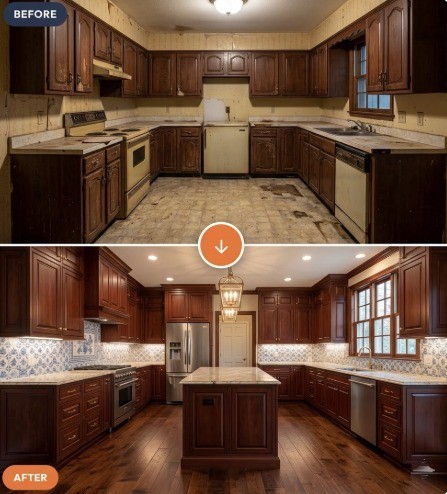
Before
After
Program guidelines on this page last verified . Guidelines, limits and program terms change — verified figures are current as of that date, not a commitment to lend.
A renovation loan finances the purchase price plus the repair budget in one mortgage, based on what the home will be worth after the work is done. FHA 203(k) and Fannie Mae HomeStyle are the two most common, and in New York there are two more worth knowing: SONYMA RemodelNY, which keeps down payment assistance in play, and VA renovation, which stays zero down for Veterans. Funds are released in draws as work is completed, with a contingency reserve required.
Whether it needs cosmetic updates or major repairs, renovation financing rolls the cost of the work into one mortgage - on a home you're buying or the one you already live in.
Every project is different - so there's more than one way to get it done. Government-backed, conventional, or New York's own program with down payment help attached. Here's the plain-English version. We'll match you to the right one; no homework required.
Best for buyers making it their home who want an easier path to qualify.
Great when the house needs work - and you need flexibility.
Best for buyers, second-home owners, and investors who want the most options.
The Swiss-army knife of renovation loans.
Best for first-time buyers in New York buying a home that needs work.
The one most first-time buyers never hear about. See RemodelNY →
Best for Veterans and active duty buying a home that will not pass as-is.
Keeps a Veteran from losing the house over a condition call. See VA loans →
Buy it and fund the work in a single loan - no second mortgage, no draining savings for repairs.
Tap your equity to renovate the place you're in - one new loan covers the whole project.
Buying a fixer or refinancing the home you already own - estimate the new payment, loan amount and the equity the work creates. Switch between Purchase & renovate and Refinance & renovate right in the tool.
Estimates only - not a commitment to lend. Let's turn the estimate into a real, underwritten approval.
I love this program. It's completely changing a market - and I'm finally in the right place at the right time.
Buyers: sick and tired of getting beat out on every offer you submit? Racing all over to see these 100% turnkey, done-to-the-nines homes - only to find out the only way to land one is to outbid someone else, half the time not even knowing if that competing offer was ever real? Insanity.
What if you bought a home that's a little banged up, needs some love - and put in the improvements you want to see, instead of living with someone else's taste? Do you think our parents would ever overbid for anything - let alone a house?
Let's open up more buying opportunities for the buyers right here in the Capital District.
Renovation financing isn't just a buyer's tool - it's a way for homeowners to reinvest, a deal-saver for sellers, and a serious edge for agents.
Stay right where you are and make it the home you always wanted.
Sometimes the best move is the one that keeps you home.
Why settle for someone else's taste when you can create your own?
Access a much larger inventory - homes everyone else overlooks.
A home doesn't have to be perfect to sell. It just needs the right strategy behind it.
What once killed a deal can become the reason it closes.
Instead of watching deals fall apart or fighting over turnkey listings…
Create solutions where everyone else sees roadblocks.
Got a house that's been shown by plenty of Realtors - but the offers just aren't coming? Maybe it's the dated kitchen, or bathrooms still original to the 1970's. Buyers, unfortunately, can't always look past that.
When I was a Realtor, I'd walk people through a home I knew was perfect for them - and they'd get hung up on the awful paint colors. I get it. But you're missing the big picture.
Cracks in the foundation and water infiltration - now that's a bit more of a big deal. Renovation financing lets a buyer see past the cosmetics and fix what actually matters.
Capital Region housing stock is old, and old houses fail inspections. That is not a dead deal, it is a renovation file.
Beautiful bones, original everything. Knob-and-tube, a bathroom that has to come out, a kitchen from another era. Conventional says no on condition. Renovation financing prices the finished house.
An owner-occupied multi with a vacant upstairs. The repairs to make that unit rentable go into the same loan, and the future rent can help you qualify.
Structurally fine, laid out for a different decade. Open the wall, redo the baths, replace the windows. Priced on what it becomes, not what it is.
The classic FHA condition call. A repair escrow or a renovation loan handles it in one closing instead of asking a seller to fund repairs they cannot afford.
Don't let a failed inspection kill your commission. An un-lendable property and a closed file are often the same house with a different loan behind it.
Send me the address and the inspection report before you release the buyer. If renovation financing can save it, I will tell you that day — and if it can't, I will tell you that too. Talk it through with me →
On a renovation loan, your contractor is part of the file. If they can't produce this paperwork, the loan stalls, the draws stop, and you are the one living in a half-finished house. Six questions, asked before you sign, save all of it. Print this and hand it to every bid.
You are confirming the business legally exists and is ready to take on this type of project — not a side operation that folds mid-job.
A contractor who can't answer this will never clear underwriting.Requirements vary by town and county across the Capital Region. What Albany requires isn't what Troy requires.
Ask for the actual number, then verify it yourself.The full validation process will ask for a certificate of coverage. "I'll get it" is not the same as having it.
Uninsured damage to your house becomes your problem, not theirs.If they truly have no employees, a lawful exemption may apply — but it has to be documented, not asserted.
An injured worker with no coverage can put a lien on your home.Two separate things: relevant experience, and enough capacity to actually serve you well. Call the references. Ask if the job finished on schedule.
An overbooked good contractor fails you the same way a bad one does.These are standard parts of any renovation-loan project. A contractor who bristles at them has never done one.
This is the question that separates renovation contractors from everyone else.Not sure whether a bid will clear underwriting? Send it to me before you sign. I review contractor packages on renovation files every week, and I'll tell you the same day what's missing.
Have me review a bid →Licensing, insurance and exemption requirements vary by location. I can help clarify what applies to your project before you commit to a contractor.
Want to create a different market - and be part of something special? That's exactly what RENO loans are all about.
Aren't you tired of bidding on the same listing as two other agents in your own office? Sick of the only advice you can give your desperate buyers being "overpay and hope you get it"? That's not a great strategy. Let's change that.
Think about that home you drove past - listed right in the same neighborhood, just a little banged up. Original kitchen, original bathrooms, landscaping straight out of the 70's.
And we can help everyone visualize a beautiful, finished home.
It's not just a loan -
it's a strategy.
Renovation financing connects buyers to more homes, helps sellers move properties that otherwise wouldn't sell, and gives agents a powerful tool to keep deals alive and moving forward. At Brian Marchand, we don't just finance homes - we help reimagine what's possible.
A renovation loan is how you buy the house nobody else can get financed and finish it with one mortgage. It's also more paperwork than a normal purchase, and sometimes the simpler route wins.
Paint, carpet, a light fixture package. A renovation loan adds a consultant, a contractor bid process, and draw inspections. Just buy the house and use cash or a credit line for small work.
Conventional loans →HELOC and home equity →If you have equity and good credit, a HELOC or a cash-out refinance is dramatically simpler than a renovation loan — no contractor approval, no draw inspections, no consultant.
HELOC and home equity →HELOC vs cash-out →Most renovation programs require licensed contractors. Self-help provisions are narrow, rarely approved, and never cover your labor as a draw. If you’re DIY, this isn’t your product.
HELOC and home equity →Bids, a scope of work, a consultant where required, and lender approval of the contractor all take time. In a fast bidding war this program is a disadvantage.
FHA loans →Ground-up construction and full teardowns belong on a construction loan, not a renovation loan.
Construction loans →Renovation loans lend against the appraised value after the work is done. If you’re putting $120K into a house that will only appraise $60K higher, the loan won’t support it — and honestly, you shouldn’t do it.
Talk to Brian →Income is documented normally on these loans. What changes is that you have to qualify for the full loan amount — purchase price plus renovation budget — not just the price of the house.
Remember that you’re qualifying on the combined loan — house plus renovation. A $250K house with an $80K renovation is a $330K mortgage payment for DTI purposes, and I’ll show you that number before you fall for the house.
Renovation files die in the contractor and scope phase far more often than in credit. Handled in the right order they're very manageable.
No license, no insurance, no references, unwilling to work within a draw schedule, or unwilling to submit financials. The single most common failure on these loans.
I give you the contractor requirements before you collect bids, so you're only getting quotes from contractors who can actually be approved. That saves weeks and a lot of frustration.
Three bids with different scopes, missing line items, no permit costs, no contingency. Underwriting can’t approve a budget it can’t verify.
We build the scope of work document first, then bid it. Same scope, comparable numbers, permits and contingency included — and a consultant engaged where the program requires one.
The appraiser doesn't see the value the renovation will add, or the neighborhood ceiling caps it. The loan amount drops and the project is underfunded.
I get the plans and the scope to the appraiser with the order and I know the value ceiling in each Capital Region neighborhood. If the numbers don't work, you hear it from me before you spend money.
A contractor begins work before closing or without permits. Most renovation programs prohibit both, and it can void the loan.
Nobody swings a hammer until we close. I tell you and the contractor that explicitly, in writing, at the start.
Structural surprises behind a wall, a code requirement nobody anticipated. Without contingency the project stalls half-finished — the worst outcome in this business.
We fund a contingency into the budget deliberately. On older Capital Region housing stock I push for more contingency, not less, because something always turns up.
Renovation programs have completion deadlines. A slow contractor or a long permit queue can breach them.
I set a realistic schedule with your contractor at the start, including permit lead times for your specific municipality, and I monitor the draws so slippage gets caught early.
Already been denied somewhere else? Read what happened when other buyers brought me a dead file →
Albany and the Capital Region are home — and I’m licensed across all of New York State.
Don't see your town? Reach out — or see every Capital Region town.
Pulled from the full Q&A and grouped by stage of the project.

Brian Marchand · Sr. Loan Consultant, New American Funding · NMLS #481563
Works on FHA 203(k) and HomeStyle renovation financing for buyers and homeowners in Albany, NY and the Capital Region. Licensed in New York State. New American Funding, NMLS #6606 · 18 Computer Dr E, Suite 103, Albany, NY 12205.