
Open rural land at golden hour in New York's Capital Region
Home  /  Loan Programs  /  Land & Lot Loans
Land & Lot Financing

Got land?
Let's fund it.

Whether you're planting roots for a future build or securing acreage before someone else does, I finance vacant land across the Capital Region - when others won't. Two paths, your choice.

Vacant land & building lots
Loans up to $1.2M
Financing when others say no
Program guidelines on this page last verified . Guidelines, limits and program terms change — verified figures are current as of that date, not a commitment to lend.

Buy the land now, build when you're ready

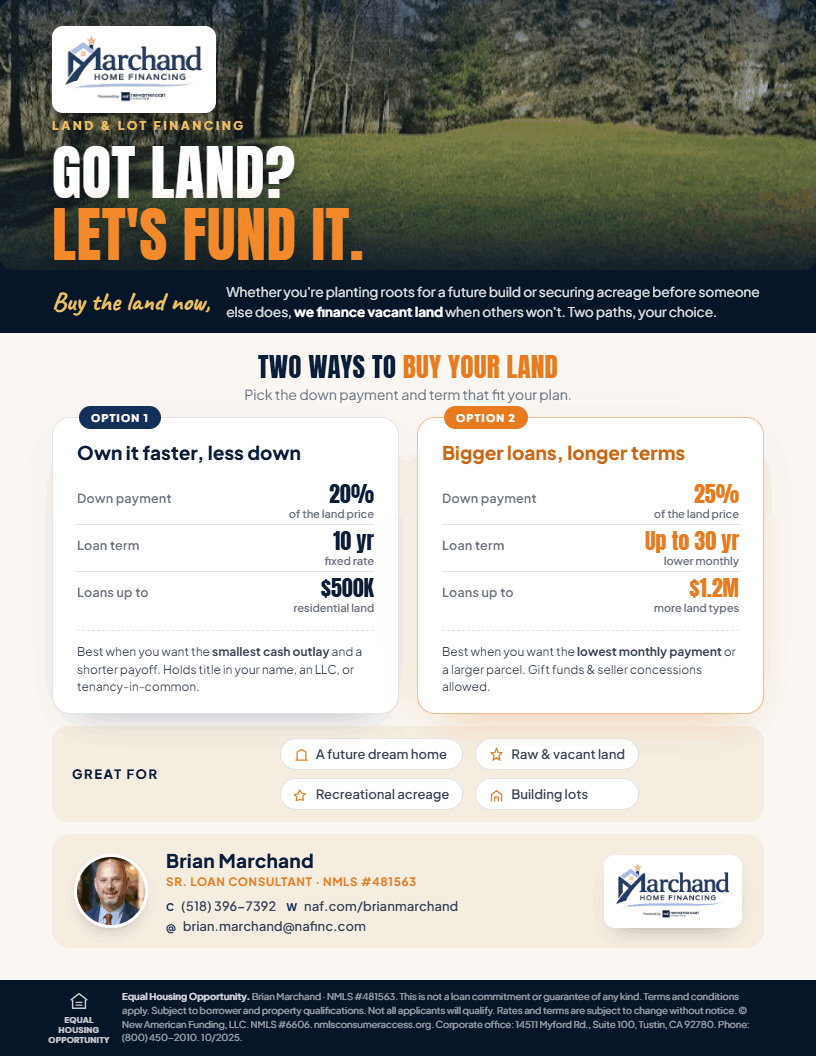
Two ways to buy your land

Big banks shy away from vacant land. I don't. Pick the down payment and term that fit your plan - or let the calculator pick for you.

Option 1
Own it faster, less down
  • Down payment20%of the land price
  • Loan term10 yrfixed rate
  • Loans up to$500Kresidential land
Best when you want the smallest cash outlay and a shorter payoff. Holds title in your name, an LLC, or tenancy-in-common. Own funds only.
Option 2
Bigger loans, longer terms
  • Down payment25%of the land price
  • Loan termUp to 30 yrlower monthly
  • Loans up to$1.2Mmore land types
Best when you want the lowest monthly payment or a larger parcel. Gift funds & seller concessions allowed.
A future dream home Raw & vacant land Recreational acreage Building lots
No guessing required

Not sure which one
suits you best?

Answer a few quick questions and my Number Crunch calculator will point you straight to the land loan that fits - Homestead or Frontier - with a real estimated payment. It opens right on Land, so you don't even have to think about it.

Sixty seconds · no email required · estimate only
Print flyer Got Land? land loan flyer - The Homestead and The Frontier programs
Program guidelines

The specs, in plain English.

Land lending is portfolio lending — these are the typical guardrails rather than agency rules. When you call, I'll tell you exactly where your parcel and your file sit on each line.

Land & Lot Loans · Typical Guidelines

GuidelineOption 1 · shorter termOption 2 · larger loans
Down payment20% of the land price25-35% depending on parcel and use
Loan term10-year fixed15-20 year options
Loan amountUp to $500KUp to $1.2M
Minimum FICOTypically 680+ · best pricing 720+Typically 700+
Property typesVacant residential land · building lots · raw acreage · recreational parcelsSame, plus larger acreage tracts
AcreageNo hard cap — value has to be supportable by comparable land salesSame
Title vestingIndividual, LLC, or tenancy-in-commonSame
Down payment sourceYour own funds — gifts generally not permittedYour own funds
ReservesTypically 6 months of the land payment6-12 months
OccupancyN/A — land is unimproved; no occupancy testSame
AppraisalLand appraisal using comparable vacant-land sales, not improved-home compsSame
Path to buildingRefinance into a construction loan when you’re ready — land equity typically counts toward the build’s down paymentSame
Straight talk

Who a land loan is not for.

I finance vacant land when most lenders won't, and I'd still rather you hear the honest version. There are several situations where a land loan is the wrong instrument.

You’re breaking ground within a few months

If the build is starting now, go straight to a construction loan. It rolls the land purchase and the build into one financing and saves you a second set of closing costs.

Construction loans →

You have less than 20% down

Land loans are equity products — 20% minimum and often 25-35% on raw acreage. There is no low-down-payment land loan anywhere, and a gift generally can’t cover it.

Talk to Brian →

You’re buying land with a house on it

If the parcel has a habitable dwelling, that’s a home purchase — conventional, FHA, or USDA — at far better terms than a land loan, even with a lot of acreage.

Conventional loans →USDA loans →

The parcel isn’t buildable and you intend to build

No road access, a failed perc test, wetlands, or zoning that prohibits a residence. The loan may still be possible, but you’d be financing a plan that can’t happen. Do the due diligence first.

Talk it through →

You already own the land free and clear

If the land is paid off and you want cash out of it, that’s a different structure — and if a build is coming, the land equity is usually more valuable as construction down payment than as cash.

Construction loans →HELOC and home equity →

You’re buying commercial or farm-operating acreage

Working farms, timber operations, and commercial parcels are a different lending world with different underwriting. This program is for residential land and building lots.

Talk to Brian →
Qualifying income

What income we can actually use.

Land loans are portfolio products, so income documentation is flexible — but the payment has to fit your ratios alongside everything else you owe, including the mortgage on the house you live in now.

Counts toward qualifying

  • W-2 wages — Standard two-year history, paystubs and W-2s.
  • Self-employment income — Two years of returns. Bank statement documentation is available with some land investors when returns understate the income.
  • Bonus, overtime, and commission — Two-year average with documented history.
  • Rental income — Leases plus Schedule E on properties you own.
  • Retirement, pension, Social Security — Documented and continuing — common on recreational land purchases.
  • Reserves — Not income, but land loans generally require six to twelve months of the land payment in reserve. Budget for it separately from the down payment.

Doesn't count (or counts against you)

  • The land’s future value — Appreciation isn’t income and doesn’t help your ratios.
  • Timber, lease, or hunting-rights income — Rarely usable as qualifying income on a residential land loan.
  • Gift funds for the down payment — Most land programs require your own funds. Confirm before you plan around family help.
  • Income starting after you build — A plan to rent a future structure or run a business on the parcel can’t be counted today.
  • Cash with no paper trail — Same as every other loan — if it isn’t documented, it doesn’t exist.

The payment on a land loan is real money for something that doesn’t shelter you yet. I’ll run it next to your current housing cost so you see the true combined number before you commit.

Failure points

Why land loans get denied — and what I do about it.

Land files die on the parcel and the appraisal far more than on the borrower. Doing the property homework first is what makes these close.

Why it dies

The appraisal can’t find comparable land sales

Vacant-land comps are thin in much of upstate New York. Without recent comparable sales the appraiser can't support the contract price and the loan shrinks or dies.

What I do

I look for recent land sales in the area before you go under contract and get whatever I can find to the appraiser with the order. On truly comp-less parcels I'll tell you the risk honestly rather than letting the appraisal be a surprise.

Why it dies

Access or easement problems

No deeded road frontage, a right-of-way across a neighbor's land that isn't recorded, or a seasonal-only road. Lenders won't lend on a parcel you can't legally reach year-round.

What I do

Title and access get reviewed early. If the access is by unrecorded easement, we address it with your attorney before closing rather than discovering it in title review.

Why it dies

The parcel turns out not to be buildable

A failed perc test, wetlands delineation, zoning that prohibits residential use, or no feasible well location. It affects both value and your actual plan.

What I do

I tell you which due diligence to complete before you commit — perc, zoning, wetlands, well feasibility — and I'd rather you spend a few hundred dollars on tests than a down payment on land you can't use.

Why it dies

Reserves or down payment source problems

The borrower has the 20% but not the reserves, or the down payment includes a family gift most land programs won't accept.

What I do

I size the full requirement — down payment from your own funds, closing costs, and six to twelve months of reserves — in the first conversation.

Why it dies

Subdivision or survey issues

The parcel was split off and never properly subdivided, the legal description doesn't match the survey, or the tax map shows something different from the deed.

What I do

A current survey and a clean legal description get sorted before closing. In New York these take weeks, so we start early — not after the title report raises it.

Why it dies

Title in an entity without documentation

Buying in an LLC without the operating agreement, formation certificate, EIN, or good-standing certificate ready. The file stalls at the closing table.

What I do

If you're closing in an entity, we collect the full package at the start and confirm the LLC is in good standing with the state before we schedule a closing.

Already been denied somewhere else? Read what happened when other buyers brought me a dead file →

Common questions

What people ask before we start.

Why is land harder to finance than a house?

A vacant parcel produces no income, houses nobody, and is slower to sell if a lender has to foreclose. That risk shows up as a larger down payment, a shorter term, and a higher rate than a home loan. It also means most big banks simply don’t offer land loans at all — which is why buyers get told no and assume it can’t be done.

Can I use the land as my down payment when I build?

Usually yes, and this is the strategy behind most land purchases I finance. When you’re ready to build, the lot’s appraised value typically counts toward your equity in the construction loan — often covering most or all of the down payment requirement. Buy the land now, let it appreciate, and build later with less cash out of pocket.

Do I need to build right away?

No. A land loan is a standalone mortgage on the parcel with no requirement that you ever build. Plenty of my clients buy acreage to hold, to hunt, or to keep a neighbor from developing it. When and whether you build is your decision.

How is land appraised?

Against comparable vacant-land sales — not against what a finished house on the parcel would be worth. That distinction matters enormously in upstate New York, where land comps can be scarce and a single recent sale down the road can drive the whole valuation.

Can I buy land in an LLC?

Yes. Title can be held individually, in an LLC, or as tenancy-in-common. If you’re using an entity, we’ll need the operating agreement, the formation certificate, and an EIN — worth getting in order before we apply.

What about perc tests, wells, and road access?

These don’t all affect the loan directly, but they absolutely affect whether the land is buildable — and therefore what it’s worth. Before you close on a parcel you intend to build on, know the perc test result, the well feasibility, the road frontage and access rights, and the zoning. I’ll tell you which of those the lender will require and which are simply things you should never buy land without.

More answers: every question on loan programs →

Areas served

Where I close these loans.

Albany and the Capital Region are home — and I’m licensed across all of New York State.

Don't see your town? Reach out — or see every Capital Region town.

Print & share

Got land?

A one-page rundown of land and lot financing you can hand to a client, a builder or a seller.

Open the land loan flyer →
Brian Marchand, Sr. Loan Consultant at New American Funding

Brian Marchand · Sr. Loan Consultant, New American Funding · NMLS #481563

Works on land and lot loans for buyers and homeowners in Albany, NY and the Capital Region. Licensed in New York State. New American Funding, NMLS #6606 · 18 Computer Dr E, Suite 103, Albany, NY 12205.

About Brian